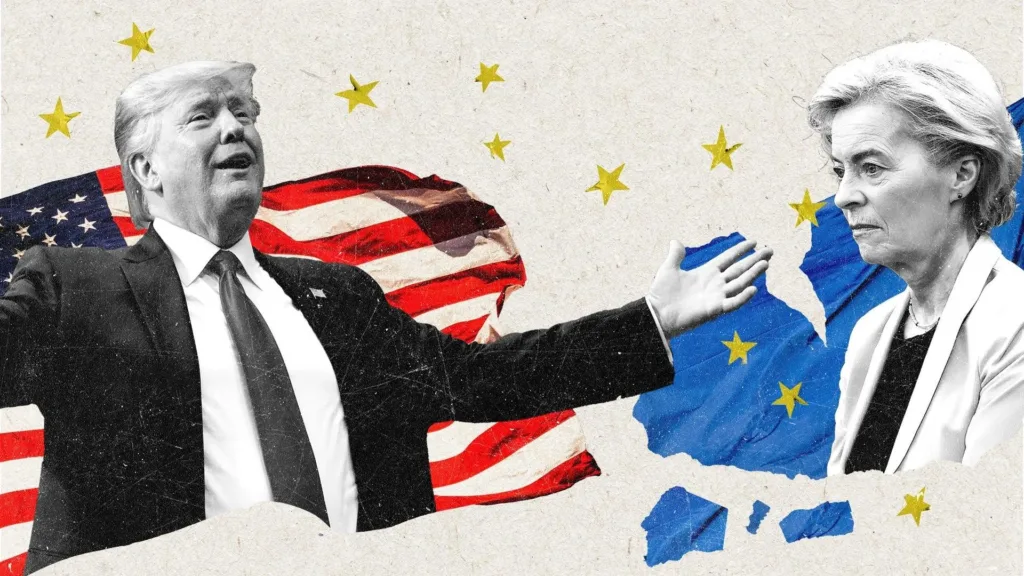
For decades, Europe has projected itself as the standard-bearer of democracy, sovereignty, and economic strength. It has often lectured the rest of the world on strategic autonomy and national dignity. Yet the recent trade agreement between the European Union and the United States exposes a very different reality—one of growing dependence and diminishing influence.
This was not a negotiation between equals. It was a demonstration of imbalance.
History offers a striking parallel. In 1842, after the Opium Wars, a defeated China was forced to sign the Treaty of Nanjing with Britain. Although framed as a “trade agreement,” it marked the beginning of what is now remembered as China’s “Century of Humiliation”—a period defined by economic control and national subjugation.
Today, Europe appears to be entering its own version of strategic submission, not through military defeat, but through political and economic weakness.
European Commission President Ursula von der Leyen’s visit to Donald Trump’s golf resort in Scotland symbolized more than diplomacy. It reflected a continent negotiating from a position of vulnerability rather than strength.
Under the terms of the deal, American goods gain significantly easier access to European markets, while European exports continue to face substantial tariffs in the United States. Europe has also stepped back from challenging major US technology firms and has committed to vast investment and energy purchases that many analysts consider unrealistic.
This is not what strong negotiation looks like. It is what dependency looks like.
What makes this situation more striking is that China in 1842 had at least suffered military defeat before accepting humiliation. Europe, by contrast, has reached this position without war—purely through strategic miscalculation and long-term dependence on external powers.
At its core, Europe’s weakness today is structural. It remains heavily reliant on the United States for defense, dependent on American technology for innovation, and constrained by its inability to act independently in global economic affairs.
For years, European leaders have spoken of global leadership. Yet when confronted with pressure, they have repeatedly prioritized short-term stability over long-term sovereignty.
Even Britain, post-Brexit, appears to have secured relatively more favorable terms—highlighting Washington’s ability to exploit divisions within Europe itself.
The irony is clear: Europe still possesses vast wealth, industrial capacity, and intellectual capital. What it lacks is strategic confidence. Instead of shaping global dynamics, it increasingly reacts to them.
This agreement may one day be remembered not merely as a trade deal, but as a symbol of Europe’s gradual geopolitical decline.
A continent that once defined global power now struggles to define its own independence.
And perhaps the most important truth of all is this:
Europe was not defeated. It chose dependence.
Syeda Nusrat Naqvi
Leave a Reply