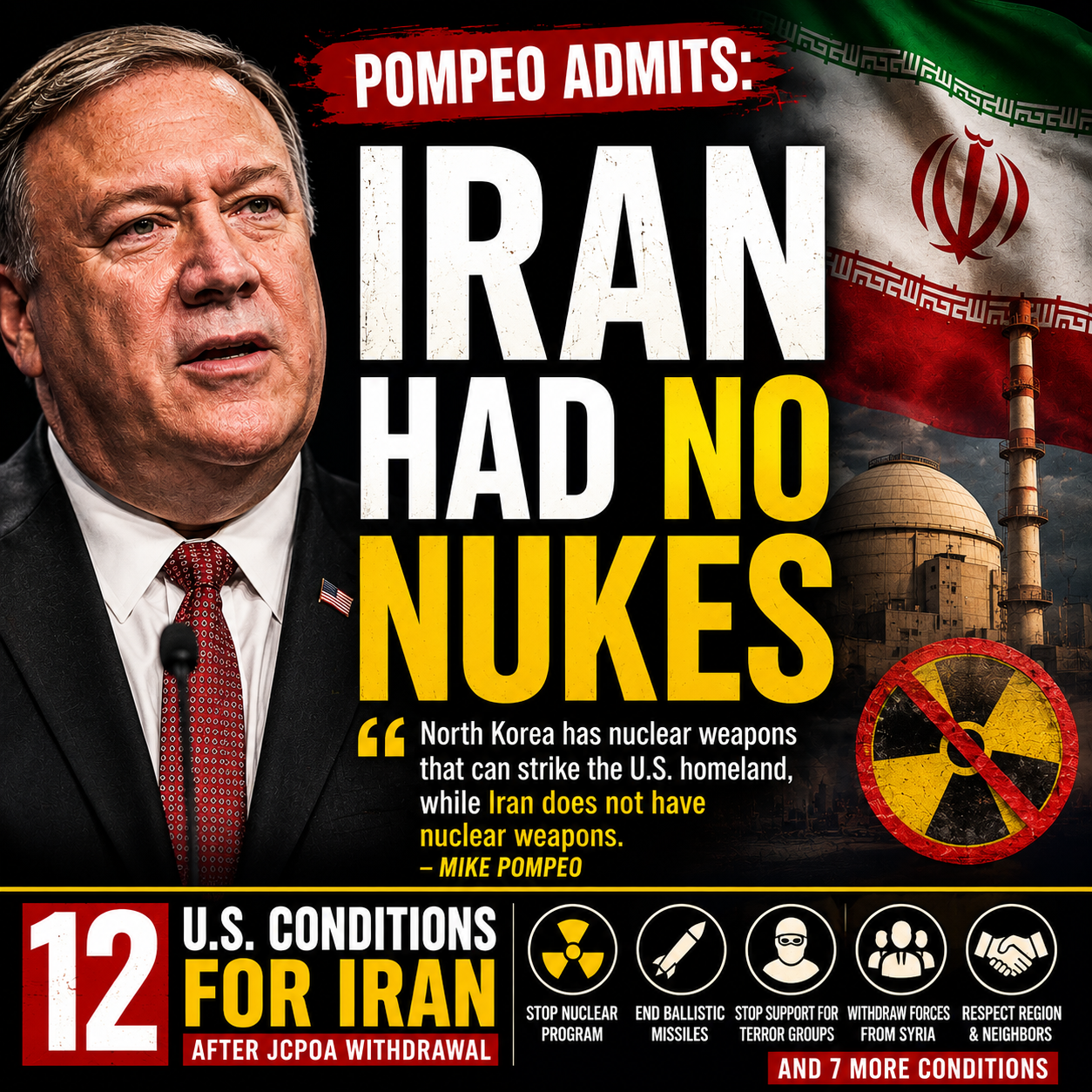
Mike Pompeo’s remarks raise serious questions about the double standards in U.S. foreign policy. If North Korea, despite possessing nuclear weapons, was considered worthy of unconditional negotiations, why was Iran subjected to twelve stringent preconditions? This contrast reinforces the perception that international politics is often driven by power rather than consistent principles. States with greater strategic leverage appear to receive different treatment, while weaker or non-nuclear nations face far stricter demands.
Pompeo’s own words expose what many view as the underlying logic of U.S. policy. North Korea entered talks without preconditions because it already had a nuclear arsenal, whereas Iran was confronted with twelve tough conditions. The question remains: are global powers guided by fairness and consistent principles, or do they ultimately respond to the realities of power politics?
🚨 Eight Years Ago: Admission by Mike Pompeo, Former U.S. Secretary of State and Former CIA Director During Trump’s First Administration
🔹 Pompeo: Iran must accept our 12 conditions.
🔹 CBS Journalist: You imposed 12 preconditions for negotiations with Iran. Why, then, did you negotiate with North Korea without any preconditions?
🔹 Pompeo: These two countries are very different. North Korea has nuclear weapons that can strike the U.S. homeland, while Iran does not have nuclear weapons.
The 12 U.S. Conditions for Renewed Negotiations with Iran After the U.S. Withdrawal from the JCPOA:
- Iran must provide the International Atomic Energy Agency (IAEA) with a full account of the possible military dimensions of its nuclear program, permanently abandon any military nuclear activities, and do so in a verifiable manner.
- Iran must stop all uranium enrichment, never pursue plutonium reprocessing, and shut down its heavy water facilities.
- Iran must grant IAEA inspectors unrestricted access to all sites across the country.
- Iran must end its ballistic missile program and cease developing or testing missiles capable of carrying nuclear warheads.
- Iran must release all U.S. citizens, as well as citizens of U.S. allies and partners who are imprisoned, missing, or detained in Iran.
- Iran must end its support for groups the United States designates as terrorist organizations, including Hezbollah, Hamas, and Palestinian Islamic Jihad.
- Iran must respect Iraq’s sovereignty and allow the Iraqi government to disarm Shiite militias and integrate them into Iraq’s official security forces.
- Iran must end its military support for the Houthis and contribute to a peaceful resolution of the conflict in Yemen.
- Iran must withdraw all forces under its command from Syria.
- Iran must end support for the Taliban and other militant groups in Afghanistan and the region, and cease harboring senior al-Qaeda members.
- Iran must end the Quds Force’s support for groups and paramilitary partners that the United States considers terrorist organizations.
- Iran must cease what the U.S. describes as threatening behavior toward its neighbors, including threats against Israel, missile attacks on Saudi Arabia and the United Arab Emirates, interference with international shipping, and cyberattacks.
Leave a Reply