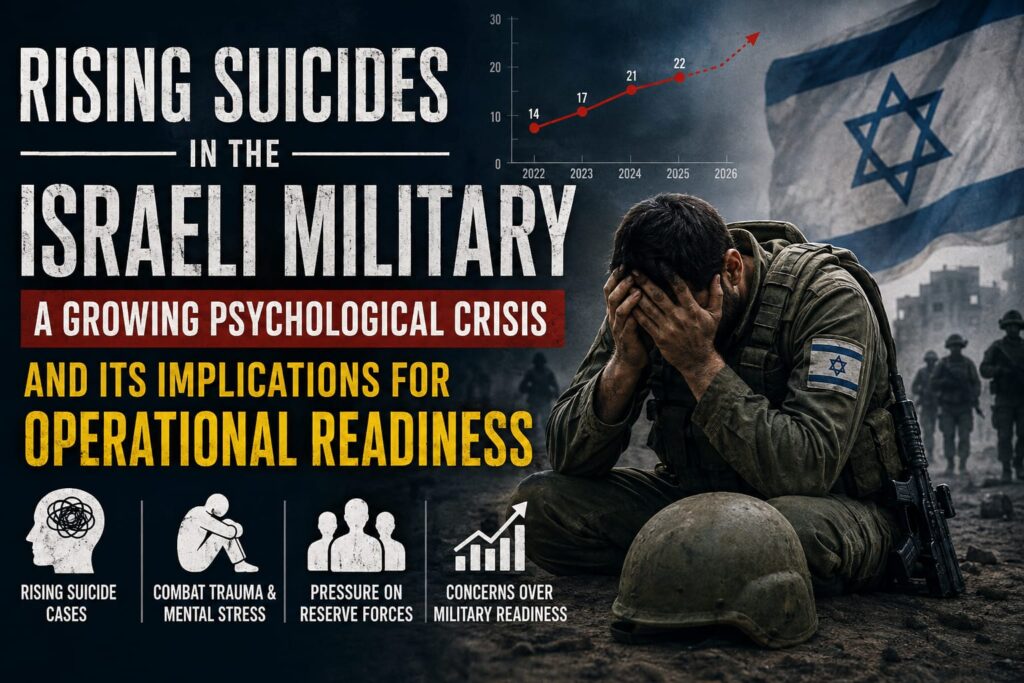
An in-depth analysis of rising suicide cases, combat trauma, psychological stress, and the growing challenges confronting the Israeli military’s operational readiness.
The Israeli military has long projected itself as one of the Middle East’s most disciplined, technologically advanced, and combat-ready armed forces. For decades, its operational doctrine has rested not only on superior intelligence, advanced weaponry, and military technology, but also on the resilience, motivation, and psychological endurance of its soldiers. Recent official statistics, parliamentary reports, academic research, and media investigations, however, suggest that the institution is facing an increasingly serious internal challenge. The steady rise in suicides among military personnel has become a subject of growing concern, raising important questions about the human cost of prolonged warfare and the long-term sustainability of Israel’s military establishment.
The phenomenon is no longer viewed as a series of isolated personal tragedies. Instead, many observers regard it as an indicator of mounting psychological pressure within the armed forces. Behind every statistic lies a soldier exposed to prolonged combat, repeated deployments, emotional exhaustion, traumatic experiences, and the difficult transition between the battlefield and civilian life. As these cases continue to increase, the discussion has expanded beyond mental health to include broader concerns about military readiness, institutional resilience, and the future effectiveness of Israel’s armed forces.
Official figures released in recent years illustrate a clear upward trend. According to publicly available military and Knesset data, fourteen soldiers died by suicide in 2022. The number increased to seventeen in 2023, twenty-one in 2024, and twenty-two in 2025, representing the highest annual total recorded in approximately fifteen years. Reports published during 2026 indicate that additional cases have already occurred, suggesting that the trend has continued rather than subsided.
Statistics presented before the Israeli Knesset reveal several important characteristics of these incidents. Approximately half of those who died by suicide during 2025 served in frontline combat units. Around eighty-five percent used military-issued firearms, while nearly three-quarters had never received prior treatment or follow-up care from military mental health officers before taking their own lives. These figures have intensified criticism regarding the effectiveness of psychological screening and support mechanisms available to serving personnel.
The crisis extends well beyond completed suicides. According to a report issued by the Knesset Research and Information Center, 279 suicide attempts were documented among Israeli military personnel between January 2024 and July 2025. Mental health specialists argue that completed suicides represent only the visible portion of a much broader psychological crisis affecting thousands of serving soldiers and reservists.
The Gaza war that began on 7 October 2023 appears to have significantly accelerated existing pressures. During the decade preceding the conflict, the Israeli military averaged approximately twelve suicides annually. Since the outbreak of the war, prolonged military operations, repeated reserve mobilizations, continuous combat exposure, and mounting operational demands have coincided with a noticeable increase in psychological distress among military personnel.
Military statistics may not fully reflect the scale of the problem. For years, the Israeli military counted only those soldiers who died while still in active service. Veterans who ended their lives after completing military duty were generally excluded from official statistics because they were no longer considered institutional responsibility. This policy attracted growing criticism following media investigations documenting former combat soldiers who returned from war carrying severe psychological trauma before later taking their own lives.
Public pressure eventually prompted the military to acknowledge a number of such cases. Nevertheless, independent reporting suggested that additional incidents remained outside official accounting, indicating that the actual impact of war-related psychological trauma could be substantially greater than officially reported figures suggest.
Israeli officials have offered several explanations for the growing trend. The Ministry of Defense has argued that the unprecedented mobilization of reserve forces following the Gaza conflict has placed extraordinary physical and psychological burdens upon reservists who have spent extended periods away from their families, employment, and civilian lives. Continuous deployments, uncertainty regarding future assignments, and repeated exposure to combat have significantly increased emotional strain.
The issue has also entered political debate. Knesset member Ofer Cassif, who requested one of the parliamentary reports examining military suicides, argued that the phenomenon had reached alarming proportions and warned that it could intensify after the war. He emphasized the need for comprehensive psychological support systems for soldiers, both men and women, while arguing that reducing the long-term human cost ultimately requires an end to continuous warfare and the pursuit of lasting peace.
Recognition of the crisis has reached the highest levels of military leadership. Israeli Chief of Staff Eyal Zamir publicly acknowledged that mental health has become one of the army’s most pressing concerns. He stated that thousands of soldiers are currently receiving psychological treatment and instructed commanders throughout the military to identify personnel suffering from emotional distress at an early stage. According to Zamir, seeking professional mental health care should never be viewed as a source of shame, emphasizing that timely intervention has already saved many lives.
Academic research supports many of these concerns. A major study conducted by Ben-Gurion University examined sixty-nine suicide cases involving Israeli male soldiers between 2009 and 2013 using psychiatric records, military investigations, and interviews with relatives and fellow soldiers. Researchers concluded that depression represented one of the principal contributing factors in a significant proportion of the cases. They also identified prolonged psychological stress, emotional vulnerability, and diminished coping capacity as major risk factors influencing suicidal behavior.
Earlier research conducted by the Geha Mental Health Center in cooperation with Tel Aviv University’s Sackler Faculty of Medicine reached similar conclusions. The study identified several categories of military personnel particularly vulnerable to suicide risk, including those who had previously attempted suicide, soldiers receiving psychiatric treatment, and individuals who had not sought any psychological assistance despite experiencing severe emotional distress. Researchers concluded that limited resilience under stress, higher levels of psychological anxiety, insufficient social support, and reduced problem-solving ability significantly increased vulnerability among affected soldiers.
Leave a Reply